
DESIGN 121 / DP1 / WEEK 3
Week 3 Teach One
This week helped me understand that good design direction doesn’t come from random ideas — it comes from being able to clearly connect who you’re designing for, what tension they’re living in, and why that tension is actually worth solving.
01 / WEEK OVERVIEW
What this week was really about
Week 3 felt like the point where our research had to start becoming sharper. Up until now, we had stories, quotes, and observations from interviews, but this week pushed us to ask what all of that actually meant.
The big shift was moving from just collecting interesting findings to forming insights and then turning those insights into opportunity areas. For me, that made the work feel much more intentional. It was less about saying “here’s what people told us” and more about saying “here’s the deeper pattern we think matters.”
02 / WHAT I LEARNED
Insights are more than summaries
The biggest thing I learned is that an insight is not just a cleaned-up observation. A quote by itself is not enough, and even a theme by itself is not enough. The real work is figuring out the tension underneath what people say — the gap between what they want and what they actually do.
That distinction really mattered to me. It made me realize that good synthesis is less about organizing information and more about interpreting behavior. That was probably my biggest takeaway from the week.
I also learned that not every user group is equally worth designing for. We talked a lot about viability, and I liked that because it made the process feel more grounded. A strong opportunity is not just emotionally interesting — it also has to show up often enough, matter enough, and connect to a behavior people already spend money on.
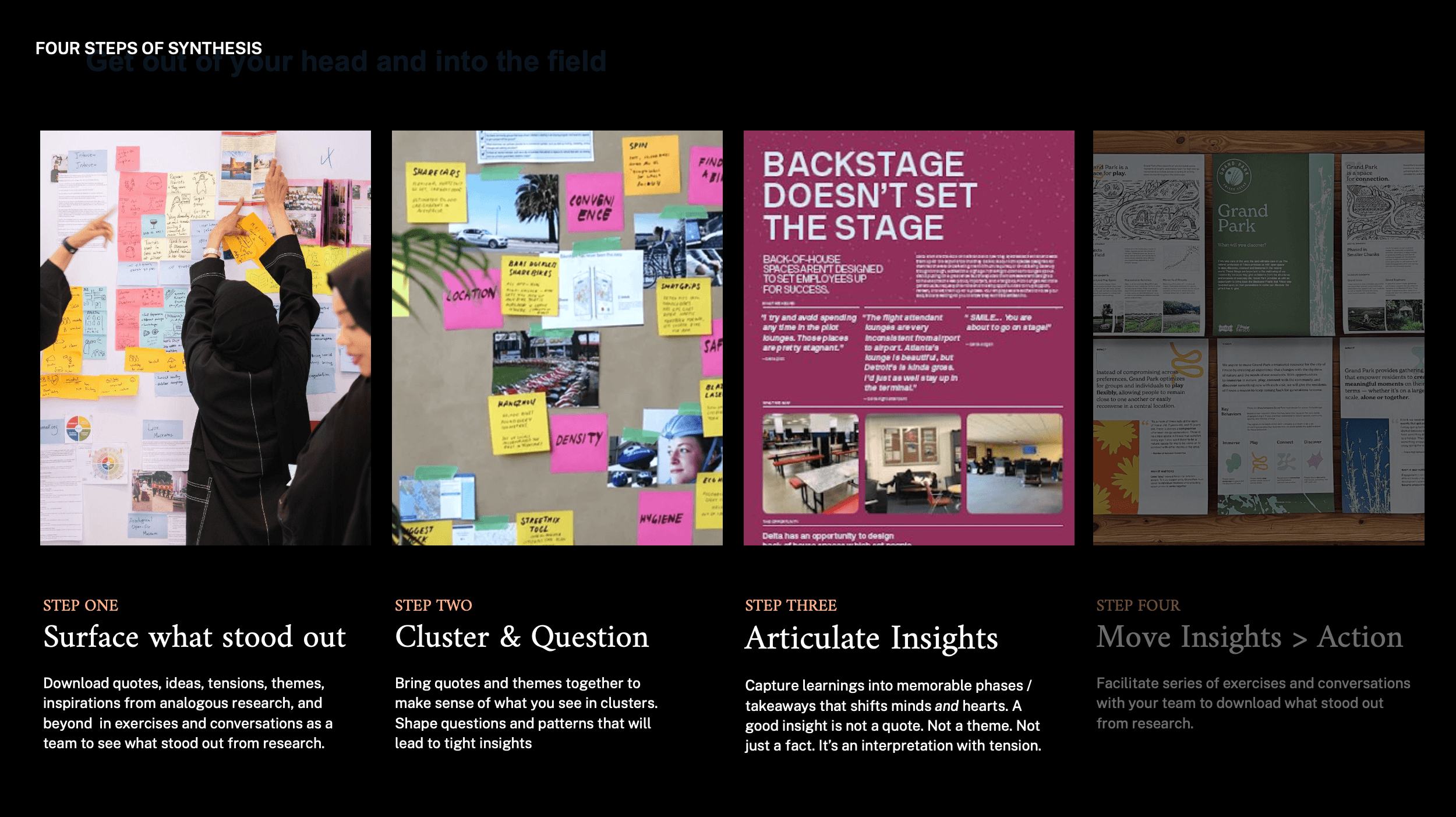
One of the most useful frameworks from the week: synthesis as a progression from surfacing what stood out, to clustering, to articulating insights, to moving those insights into action.
03 / WHAT CHANGED FOR ME
Designing for everyone is designing for no one
Another big idea that stuck with me was the emphasis on clearly defining who you design for. Before this week, it was easy for me to think too broadly — like “people who might want plant-based dairy.” But that is way too vague to design from.
What clicked for me was that the user needs to be specific in terms of mindset or behavior, not just demographics. That changes the quality of the design question. Once the user becomes more specific, the opportunity becomes more specific too.
That helped me see that narrowing your audience is not limiting the project — it is what makes the project real.
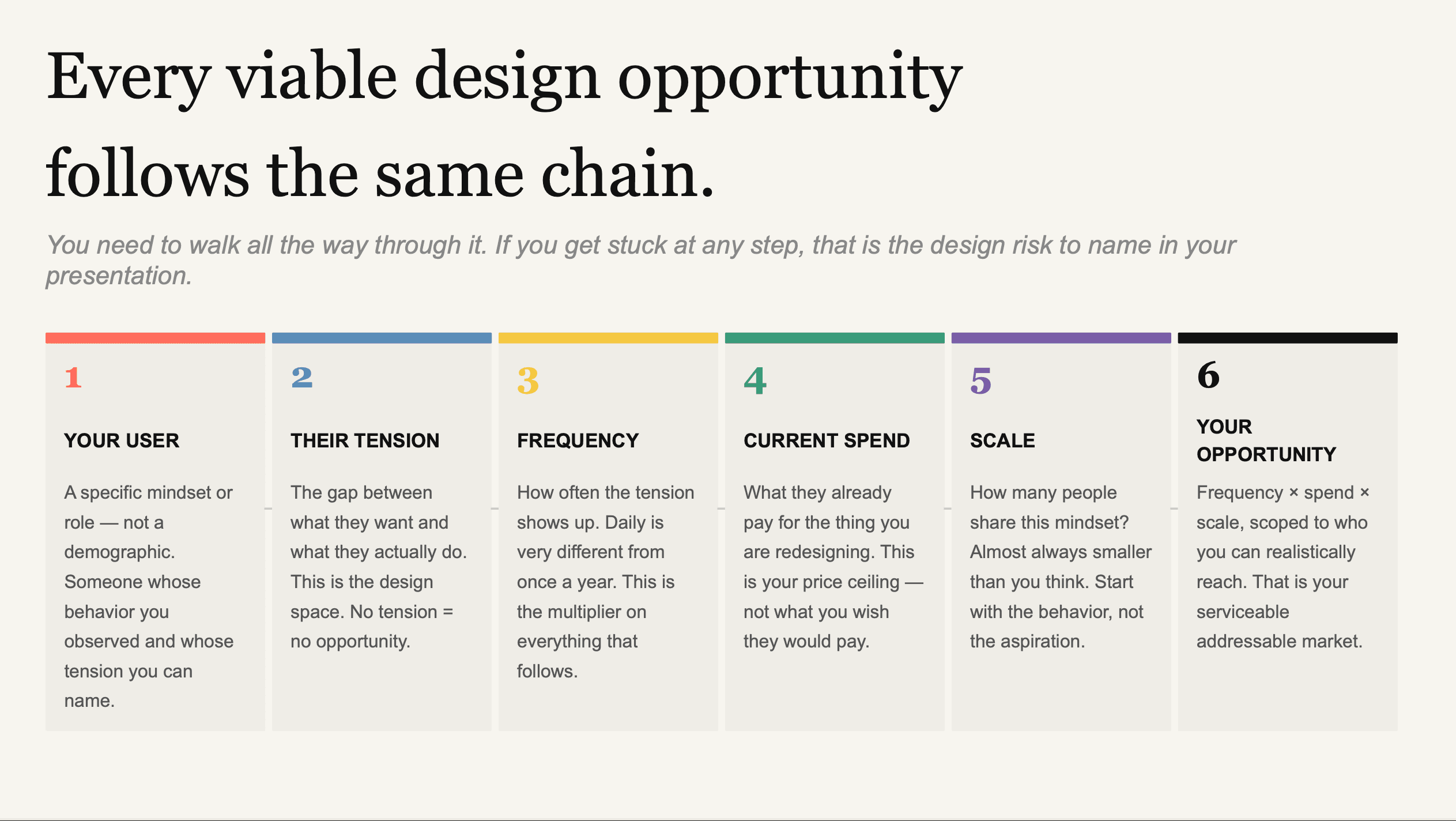
This framework made the opportunity feel more rigorous: start with the user and their tension, then think through frequency, current spend, scale, and only then define the design opportunity.
04 / HOW IT SHOWED UP IN OUR TEAM WORK
What this meant for the Forager project
In our team’s work, this week pushed us to sharpen the kinds of users we were actually talking about. Instead of staying broad, we started naming more specific roles and mindsets like the senior, the traditionalist, and the “clean freak.” What those shared was not age alone, but a preference for familiarity, routine, and products that feel trustworthy.
What I found most interesting was that a lot of the tension was not really about plant-based products being objectively worse — it was about how “newness” can feel risky. That changed how I thought about the problem. The barrier was not just taste or price; it was also perception, familiarity, and whether a product felt like it could fit into an already established routine.
That made our design space feel more nuanced. Instead of asking “how do we convince people to switch,” the better question became something closer to: how do we make the switch feel safe, familiar, and low friction?
05 / KEY THINGS I’M TAKING FORWARD
What I want to hold onto from this week
First, I want to keep remembering that research only becomes useful when it starts changing the direction of the work. If the insight does not affect what we design, then it is probably not strong enough yet.
Second, I want to be more intentional about naming tensions. I think that is where a lot of the real design opportunity lives.
And third, I’m leaving this week thinking more carefully about how to define users. Not by broad identity labels, but by the beliefs, routines, and behaviors that shape how they move through the world.
06 / MY TAKEAWAY
Teach one in a sentence
What I’m taking from Week 3 is that the strongest design opportunities come from being able to clearly name a person’s tension, understand how often it shows up in real life, and use that to move from “what we heard” to “what we should design.”