
LOADING LEVEL...
LOADING LEVEL...
CS 278 / SOCIAL COMPUTING / STANFORD UNIVERSITY
A real-time student collaboration platform that helps students discover classmates working nearby and form spontaneous study groups without needing an existing social connection.

LIVE PRODUCT
Open BetterEd →
MY ROLE
I worked primarily on the frontend experience, helping translate the team's social-computing concepts into a functional Next.js product. My work focused on building and refining interfaces for discussions, study sessions, user profiles, course enrollment, and the broader navigation experience while coordinating with the backend implementation.
TECHNICAL SYSTEM
BetterEd was designed as a technically focused CS 278 project. The frontend uses React and Next.js, while Firebase supports authentication, Firestore data, and real-time platform behavior. The technical system is directly tied to the social behavior we wanted to encourage.
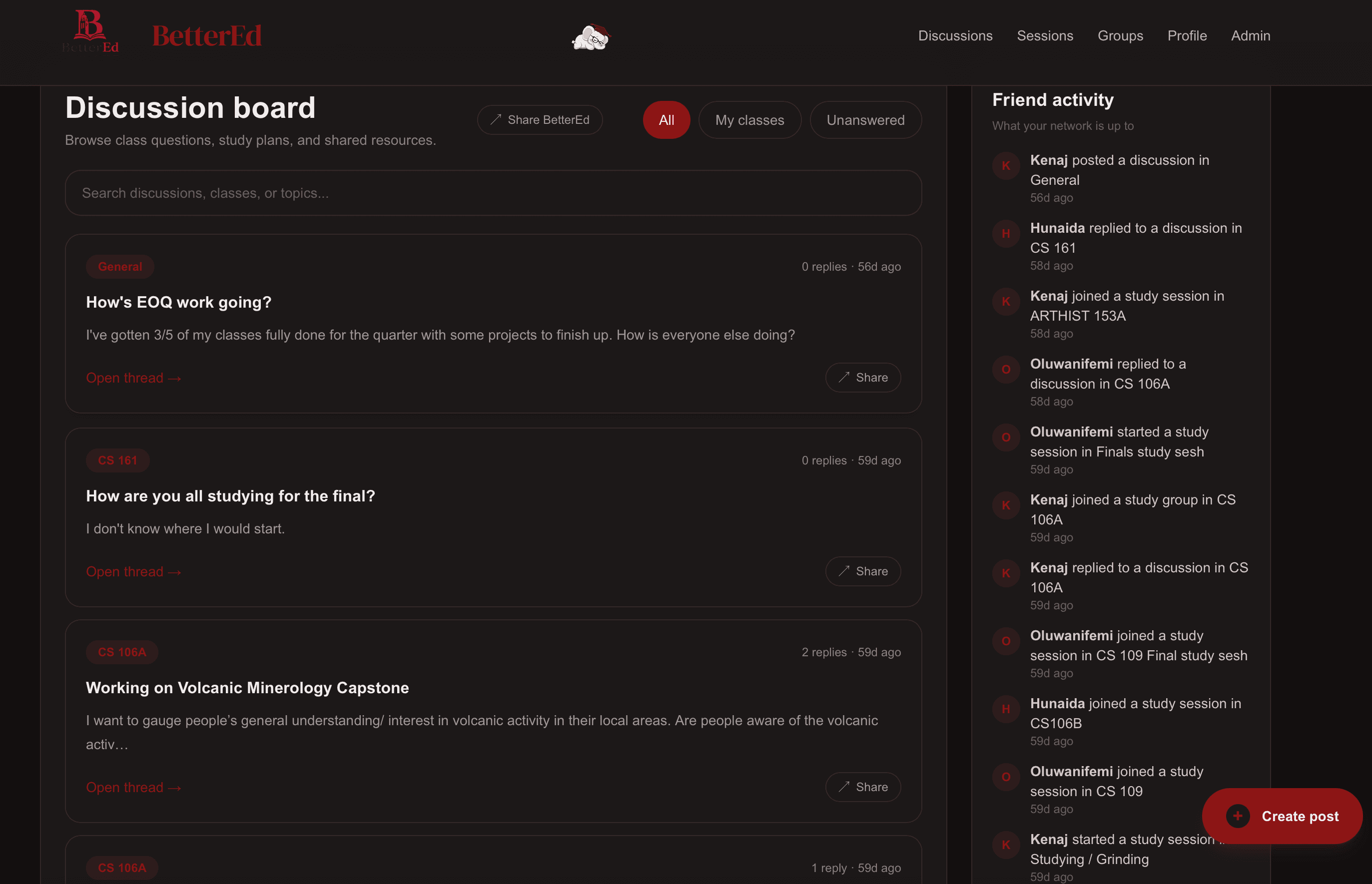
DISCUSSION BOARD
The discussion board allows students to browse questions, study plans, and shared resources by course. Users can filter discussions by their own classes, search across topics, and see activity from people in their network.
We wanted this area to feel useful without becoming another overwhelming social feed, so the design centers course context, clear discussion hierarchy, and lightweight participation.
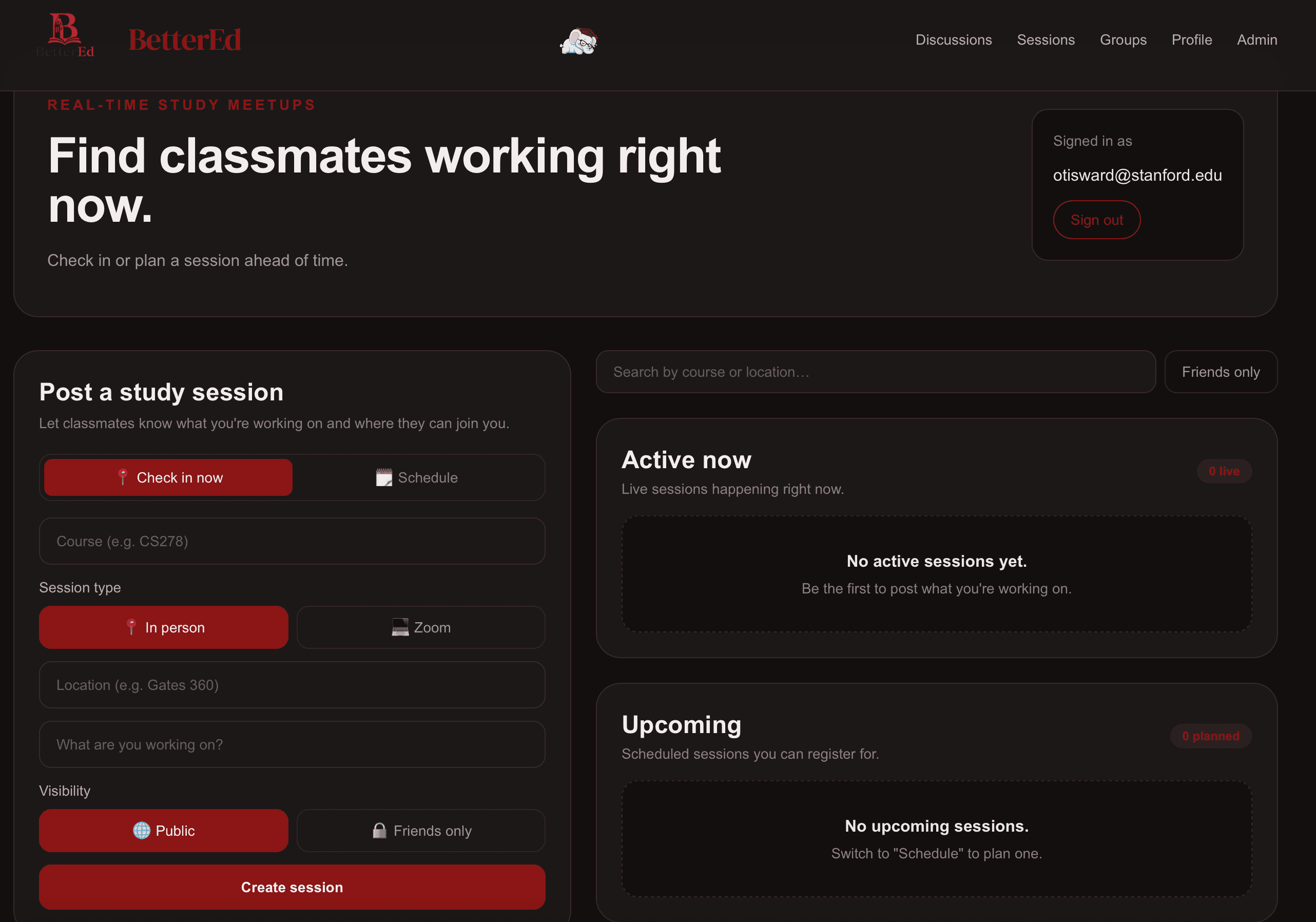
REAL-TIME SESSIONS
The core BetterEd interaction is the study-session system. Students can check in immediately or schedule a future session, select a course, describe what they are working on, choose in-person or virtual participation, and control the visibility of the session.
Our early prototype testing showed that students were much more willing to join existing sessions than create their own. That changed our design philosophy: joining needed to be easier and more prominent than posting.
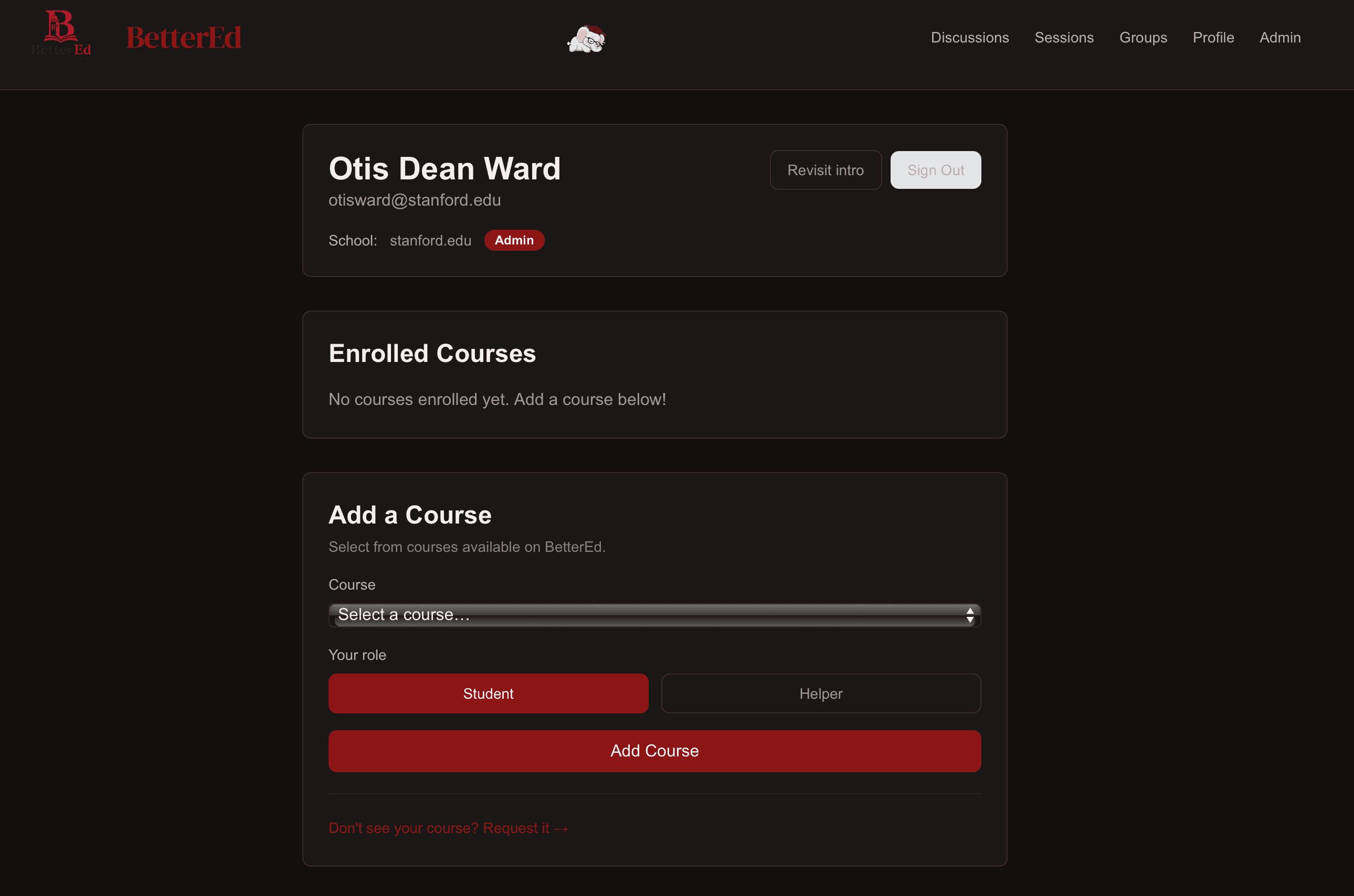
COURSE CONTEXT
Student profiles connect users to the courses they are actually enrolled in. This allows BetterEd to personalize discussions and session discovery while maintaining a stronger sense of trust than open anonymous communities.
The project also explored an Honor Code-aware system where collaboration permissions could be associated with individual courses, embedding academic-integrity rules directly into product behavior.
MODERATION + ANALYTICS
BetterEd is not only a student-facing interface. The admin dashboard provides visibility into platform activity, including users, discussions, sessions, groups, reports, and participation patterns.
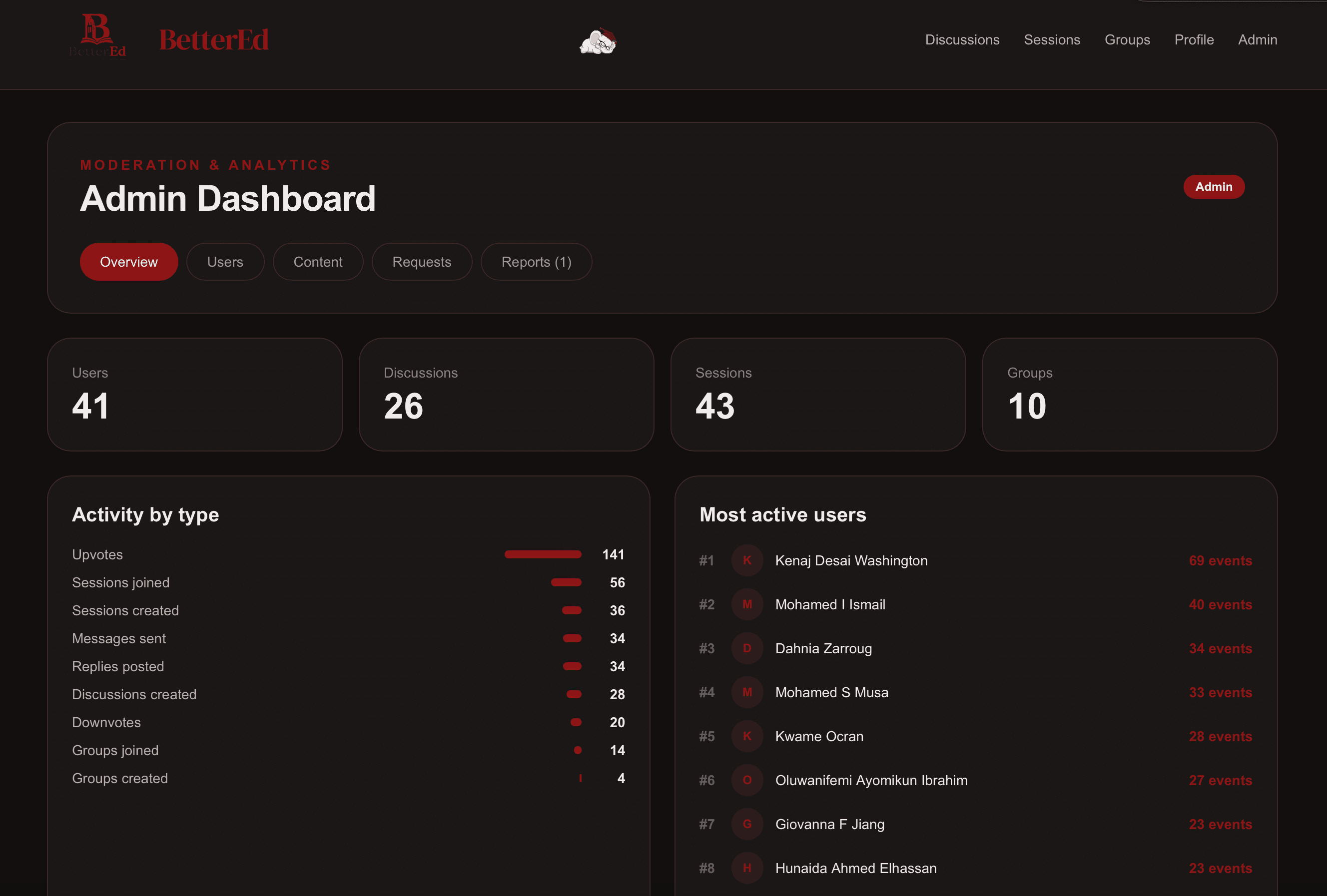
Building moderation and analytics into the platform helped us think about BetterEd as a full sociotechnical system rather than just a collection of frontend screens. Social behavior, moderation rules, trust, academic integrity, and technical architecture all influence one another.
PROTOTYPING + RESEARCH
SOCIAL COMPUTING
We expected many users to browse without posting, so BetterEd lowers the barrier to participation through lightweight joining behavior.
Surfacing active sessions can make collaboration feel normal by showing that classmates are already studying together.
Professors, TAs, and existing office hours can seed activity so the platform has value before a large student community develops.
BetterEd treats technical rules, community expectations, academic integrity, and product behavior as one connected system.
RESPONSIBLE DESIGN
KEY TAKEAWAY
BetterEd started with the question, “How do we get students to post study sessions?” Testing pushed us toward a better question: “How do we make collaboration that students already want easier to discover and join?”
That shift changed how we thought about participation, location, trust, moderation, and technical architecture. The strongest design decisions came from observing what students actually did, not assuming how they would behave.